

With a desire to become the best in our field, our in-house team, across three UK locations, focuses on understanding your business as well as current and future R&D projects.
As a company that only focuses on R&D we are also trusted by over 150 UK accountants to undertake R&D audits of their clients. At RDS we bring a huge range of business experience across multiple sectors, helping you inject valuable cash into the business.
Your company can generally claim for 65% of the payments made to unconnected parties for work carried out on R&D activity.
Your company can claim for the cost of items that are directly employed and consumed in a qualifying R&D project. Where a prototype is created to test the R&D being undertaken, the design, construction and testing costs will normally be qualifying expenses.
Your company can claim for salaries, wages, class 1 NIC and pension fund contributions for staff actively engaged in the R&D project.
Your company can claim for a proportion of water, fuel and power consumed in the R&D process.
Your company may claim for the cost of software that is directly employed in the R&D activity. Where software is only partly employed in direct R&D, an appropriate apportionment should be made.
You may claim travel and subsistence expenses to if incurred then reclaimed by the employee not paid for directly by the business. They also must be classed as a staffing cost and relate directly to the R&D activity.






Are there more than 500 employees in your business? Get in touch to find out how we can assist with RDEC claims
Below are some of the most frequently asked questions we get regarding making an R&D tax relief claim. If you have any more questions please contact our team.
Knowing which projects qualify for R&D tax relief and what expenses can be claimed, are important areas of consideration, particularly because they have the power to maximise the value of a claim.
Here are things that you CAN claim for:
Utilities (Gas, Electricity, Water).
Salaries and Wages.
Employer’s NI Contributions.
Employer’s Pension Contributions.
Materials and wastage consumed during the project.
Prototypes created.
Subcontractors’ invoices.
Software Licenses.
R&D tax credits is an incentive where UK limited companies can receive a reduction or rebate on their CT for funds spent on eligible R&D activities. This incentive was established by the government in 2000 and has continued to support businesses of all sizes and sectors to grow.
No, you do not need to create a new product to qualify for R&D tax credits. For instance, you can make significant advancement or appreciable improvement to existing machinery, in a manner that promotes efficiencies within your sector.
Yes, you can claim for unsuccessful projects if you can demonstrate that an advancement was sought, and you attempted to overcome the ‘uncertainties’ you faced during your research and development endeavours.
No, we do not bill you until you receive your benefit from HMRC. The relationship we build with our clients is based on the principles of trust and transparency. Therefore, the benefit is paid directly to you before you pay us for the services rendered.
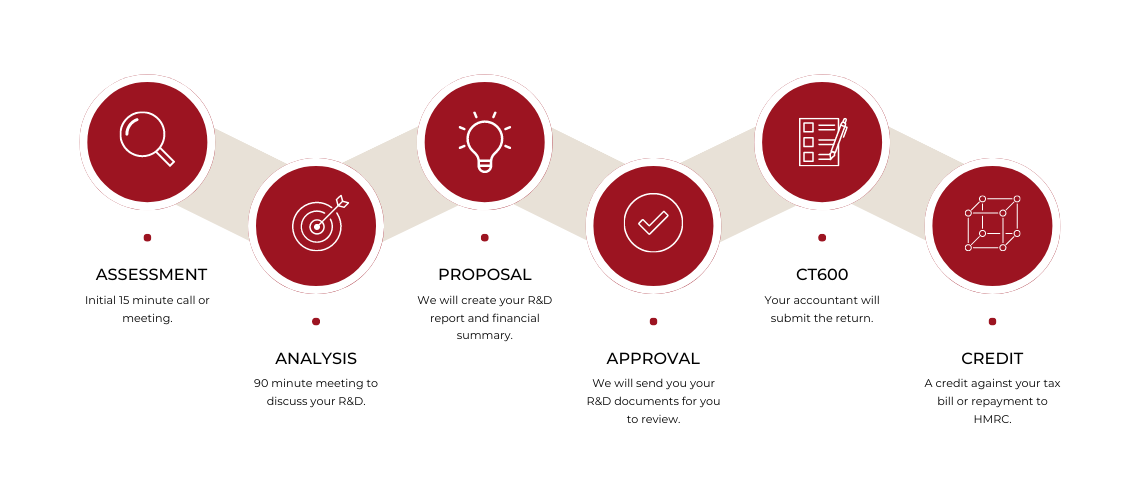
For many firms, the prospect of R&D can seem daunting and extremely complex at first, therefore RDS aim to make the process as simple and straightforward from the onset.
Step 1: A 15-minute conversation with the Business Development Team, to discuss eligibility.
Step 2: Signing of the NDA/ client agreement, dictating the terms and conditions of our service.
Step 3: Arranging and undertaking a Project Technical Report call with your dedicated financial analyst. This will entail evidencing your developmental endeavours and apportioning financial calculations to support your application with HMRC.
Step 4: Reviewing compiled information to ensure you are completely satisfied with the information collated prior to its submission to HMRC.
Step 5: We actively monitor the status of the application to ensure that any benefit is realised within the anticipated timeframe.
HMRC aim to process payable credit claims within 28 days of receiving them. However, processing time can be affected by aspects such as, time of the year. There is a general increase in demand for months like March and December.